
Tim Pierce: “My Essential Sessions and Tools of the Trade”
The Complete 2013 Interview, Part 2
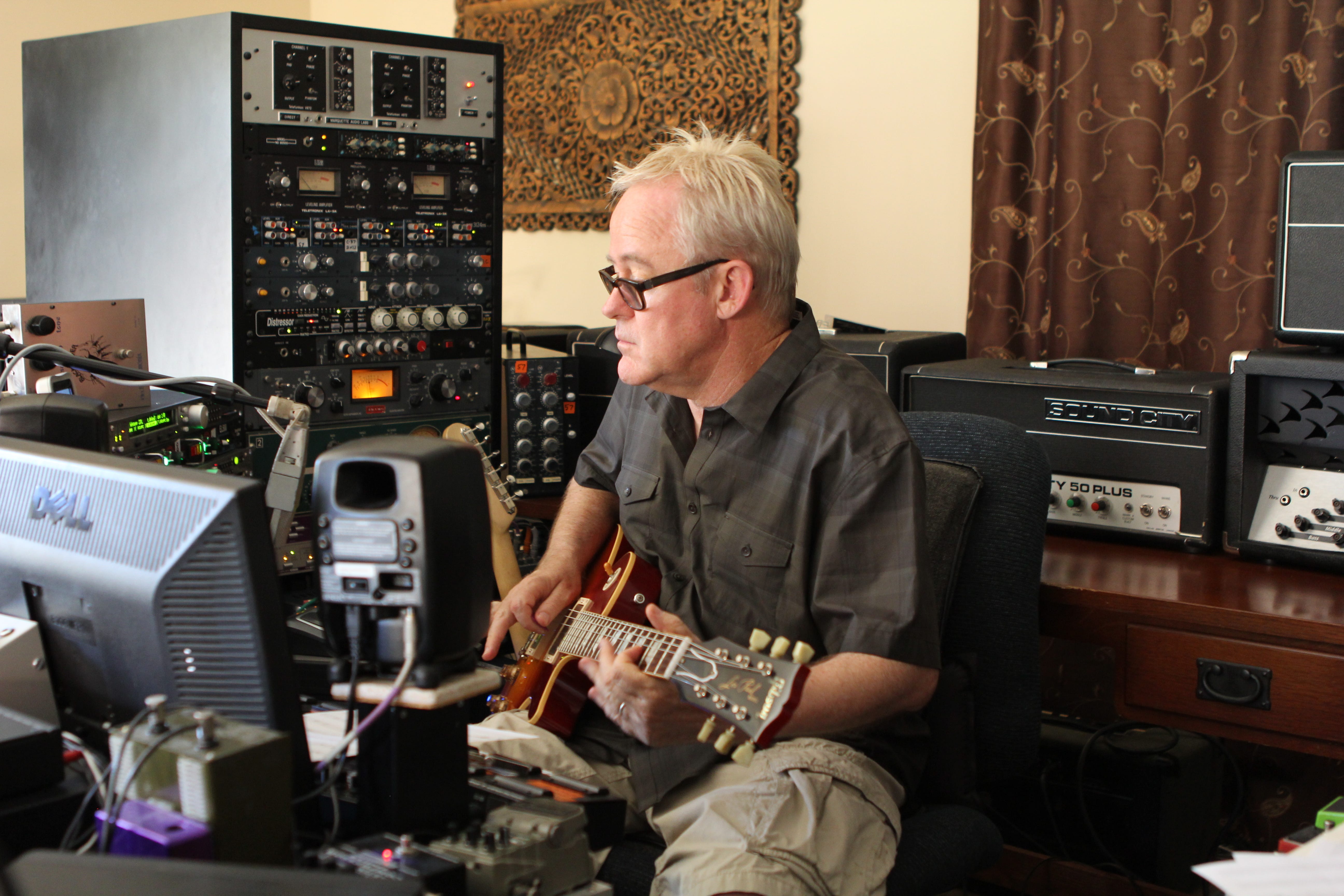
Part one has already been published as Tim Pierce: Confessions of a Studio Guitarist. Here’s the second half of our 2013 interview, in which Tim delves into his favorite appearances on record and offers insight into the tools of his trade and strategies for thriving as a session musician.
###
If somebody wanted to put out a CD of the essential Tim Pierce, which performances would have to go on there?
I have a list in my iPhone in front of me, so I’m prepared. [Dials it up.] The Goo Goo Dolls’ “Iris.” It was a huge single for them, and that was one of those phone calls where I got the phone call literally at 11:00 AM, and I was at the studio at 3:00 in the afternoon. My buddy Rob Cavallo, who I’ve worked with for 15 years—he’s now the chairman at Warner Brothers Records—that was the first day I met him. And it was maybe one of the biggest hits he’s ever had.
This is a great story. The night before, they had asked Dean Parks to play mandolin on the song. It was at Record One with Alan Sides engineering, and Dean was too tired. He’d been in the studio all day, and he said, “Please. Let me do this tomorrow.” And for whatever reason, the second engineer in the studio—and this is what I’m talking about, by staying in one place and not going on the road—the second engineer said, “Hey, why don’t you try Tim Pierce? He was here the other day.”
And so Rob Cavallo called me and said, “Hey, we need a mandolin player. Bring your mandolin and come do this.” I said, “Okay, I’ll do it. Great.” I hung up the phone and I said to myself, “I am not showing up at a rock session for the Goo Goo Dolls”—despite their name, they’re a great rock band— “with a little mandolin case.” So I put an electric rig in my car, and I showed up at the session and brought in an electric rig. I actually got to do an electric slide solo, because I refused to show up with a mandolin case. So I horned my way into it, and I was really proud of it. It was nice. And Rob and I ended up working together. I’m working with him this month on a bunch of stuff. It’s a thing that’s lasted 15 years.
That song has a powerful emotional impact.
It’s beautiful, isn’t it? Yeah, yeah. Another one would be the band Bon Jovi’s “Runaway.” It was a demo that Jon did when he was living upstairs at the Power Station. I did six songs with him with a full band at the Power Station. That single was his first single, and he put his band together after that. I watched him become the biggest rock star in the world, with the biggest band in the world. It’s one of those situations where you go, “Wait a second! Could I have gotten on that train?” [Laughs.] “How did I miss that train?” It’s such a cool thing. It’s the only demo that survived on their first record, and it was the first single.
Next would be Michael Jackson’s “Black or White.” Bill Bottrell is this great producer I worked with, who produced Toy Matinee, which is a great record that I got to do and is part of this list. He was producing Michael Jackson. He invited me in to play on a song called “Black or White.” He said, “Michael is really, really in love with Motley Crue’s ‘Doctor Feelgood’” —that’s a great rock song. He said, “I need to put something on the bridge of this song that sounds like that. Everything with Michael is a kind of a fantasy, and so I need you to turn this into Michael’s Motley Crue fantasy.”
So if you listen to the bridge of that song, you can hear the influence of Motley Crue, with me playing the heavy metal bridge. Bill Bottrell had played the signature lick on that song [sings the rhythm guitar part]—that’s Bill Bottrell. One of the benefits of sharing the work with a group of people is that there are many people who assume, because I have a credit on that song, that I played that lick. And that has not hurt me! But it’s not the truth. That’s Bill Bottrell.
Let me open up this list again. [Looks at phone.] Okay. The next one I’m going to do is Jason Mraz’s “I Won’t Give Up.” Jason Mraz had a big single last year. About a year ago I got to do his record, and we did 25 days of live tracking, and I did about three weeks of overdubs. And he is so phenomenal as an artist and musician—everything he does. The song is finished and beautiful and wonderful when he shows up and plays it for you. So what you try and do when you work it up with him is not hurt his beautiful song.
It was amazing to hear that song on the radio constantly in the year 2012 against all of the power, Lady Gaga, Katy Perry—you know, all the urban stuff—and then there’s Jason’s acoustic song. And I got to play 12-string acoustic, high-strung acoustic, a little bit of electric that you don’t hear, and 6-string acoustic. So he’s playing the gut string, and I’m doing all of the other acoustic and a couple of electric guitars around it.
Is Jason a good guy to work with?
He’s amazing. I admire him. He’s phenomenally successful, but he lives a very simple life and he uses his fame to travel around the world and take his crew with him and spread his music around. He wouldn’t care if he owned nothing. He is the real deal. When you’re working with him, he’s off in a corner, perfecting his next song. It’s just a big circle between him and his fans. It’s really amazing.
Another one: Rod Stewart’s “Broken Arrow.” That was a Robbie Robertson song. Still, to this day, it’s really beautiful. Jim Keltner played drums, Pat Leonard produced it. Beautiful.
I got to work on Shinedown’s last two records, and that’s probably the heaviest rock thing that I’ve gotten to do. Got to do some amazing stuff on that, but I do not want to encroach on Zach’s territory, because Zach [Myers] is a great guitar player, and I’m just very luck I got to share some Shinedown duties with Zach.
I’ve played on three or four Santana records, which is really bizarre. Santana, I guess he doesn’t play much rhythm guitar, so he uses rhythm guitar players. And I’ve just known the producers that work on his records. There was a hit I played on called “Why Don’t You & I,” and if you heard it, you’d recognize it. When I saw the title and looked it up last night, I thought, “I don’t remember that title.” Two singers ended up singing it—Alex Band from The Calling sang it, and then Chad Kroeger from Nickelback sang it. Chad actually ended up with the radio version because of some deal-making that happened. I play rhythm guitar, Santana plays lead, and it was actually kind of a hit.
Rick Springfield—we did a bunch of songs that actually got to have really fiery eight-bar guitar solos. There’s a song called “Love Somebody” that had one of my favorites. So that’s on the list. And there’s a new movie that Dave Grohl did called Sound City, and Rick’s a big part of it. I saw a little rough cut of the movie, and there was a photograph of me. So I got to get a photograph in the movie. Go see this movie—it’s amazing. I spent years at this studio [Sound City Studios in L.A.], and Keith Olsen’s a big part of the movie. I spent years working with Keith Olsen, and I still work with him. It’s an amazing movie, and it was an amazing studio in an amazing era, and Dave Grohl took a liking to it.
Rick Springfield—you know, we are friends, we’re family friends, we’re almost like brothers, he and I, even though I haven’t worked with him really since the ’80s. I don’t tour with him, but I love his band, I love all of his music. He’s going through another little renaissance right now.
And then, of course, Toy Matinee. That was actually the beginning of me feeling like I could actually be a studio musician. Pat Leonard put together this mega band after he had had all this Madonna success, and I got to be the guitar player. Part of the reason he hired me is because I was kind of rough around the edges and not the most obvious choice. That record became a kind of singular, high-quality musical experience that audiophiles fell in love with for a long time afterwards.
There’s an Uncle Cracker song called “Smile” that you would recognize—it’s on the radio—that I absolutely love. It’s one of my favorite pop songs. I also put down “Falling for You” by Colbie Caillat because I’ve done an enormous amount of work with her and her father, Ken. Ken produced Fleetwood Mac’s Rumours, and he’s at my studio all the time. We’re always working on new artists together, independent artists. And Colbie—when you hear her voice, it’s breathtaking. It’s just a gift. I really love her music.
And then the last one I put on here was “Don’t Dream It’s Over” by Crowded House. That was an early one, but that actually got me hooked up with songwriters. After I finished with Rick Springfield in 1987, I went broke and I started doing publishing demos for songwriters. I had played on Crowded House, and that actually got me the $100 demos that I used to do every day with songwriters. It was a grueling period of time, but that’s another thing that taught me how to do what I do for a living.
How often are you actually in the same room with the artist when you’re recording parts?
Most of the time, with exceptions. There are pop stars who are smart enough to know that they don’t want to be anywhere near the recording process, because all they’re really trying to do is be celebrities, and that involves a whole different game. They just hire people to do the work, they approve it, and they show up to sing. I don’t fault them for that. It’s just a different game.
Would this be, like, Madonna and Christina Aguilera?
No, no. Madonna would be there at all her sessions. Christina Aguilera is there for a lot of her sessions. I’m probably talking more about some of the teen stars. It’s just that they are more involved in the media machine. And what happens a lot of the time with veteran musicians is they just get bored with the process. A lot of the record production, man, it’s like watching paint dry. I don’t fault artists for not being there every minute. They’re busy, and they have stuff to do.
Have you encountered famous artists who have good insight into guitar and can give you directions in the studio?
Yes. Most of the time, the artists are there. And most of the time, they have very good instincts about the guitar parts they want. They care deeply about what they’re doing. The smartest thing for me to do is keep my mouth shut and find out what they love and what they hate. And try to not be what they hate and try to be what they love as quickly as possible.
Takes a lot of intuition.
I suppose it does, yeah.
Has anyone surprised you with their insight or given you unusual directions? Like Michael Jackson used to say things like make it more “blue” or “green.”
Sometimes the most unusual request can lead you in a direction that’s phenomenal. First you get scared, and you go, “How am I going to honor this request?” But then you start throwing stuff out.
One of the things about my job that is difficult—it’s probably hard for a lot of musicians—is there’s a certain amount of rejection. You offer something that’s your heart and soul, and it gets rejected [snaps fingers] immediately. And it’s like, “Okay. What else you got?” And then you go, “Okay. Try this.” [Snaps fingers.] “No, we don’t like that.” “What else you got?” All the air gets taken out of the room sometimes.
So having a request that is color-based or something like that actually can spur you to reach really deep inside yourself. And it’s usually something that’s obvious, but giving it a name kind of diminishes it, so it’s almost better if you approach it from that way. It kind of feels like do or die, and then you take that energy and you go, “I wanna live. I don’t want to die. So here we go—I’ll try and give you blue. I’ll try and give you green.” But in Michael Jackson’s case, he walked into the studio, he was very normal, and I looked him straight in the eye, and he was very sweet and very nice and almost childlike. He was very, very interested in my pedalboard. He said, “Man, you must just love this pedalboard—look at all those things.” The innocence of a child. It was great.
Early in your career, did you ever feel star-struck? Which would be dangerous in your line of work, I imagine.
I’ve talked about this with my friends who do this for a living, and we don’t have any photographs of the people we work with, because it’s unprofessional. When I walk into a situation, I have to present myself as an equal. I have to present myself in the exact way that we’re sitting in this room—as an equal, and as somebody that doesn’t have any of that fan energy. Consequently, after four decades of working with all these people, I have no pictures of them, because it’s unprofessional.
It’s the same in my line of work. You never ask for autographs or photos. The second you do that, you set up a wall between you and the artist. And sometimes you can’t breach it later.
Yeah. However—the truth? We used to stare at records. We’d just stare at them. You’d stare at the pilot light on the Fender amp in the photo in the background. You’d stare at every name, and you’d wonder who, you know, Jeff Porcaro is. And then you show up in a room and you’re playing with Jeff Porcaro. Of course. That was when I played with Phil Collins. I was in a room, and he was playing drums. And we did a song called “You’ll Be in My Heart” —that should have been on that list. I forgot that one. He won an Academy Award with that, which for him was amazing, because he’s a film buff and an actor. That song was in a Disney movie, and he got to go up and get handed an Academy Award, an Oscar, for that song. And when I sat across from him, it was just chills, right up and down my spine: “This is not happening!”
Have artists sent you gold records?
The way that used to work, it was easy for a while, and then it got harder. There was a Madonna record that I played on, and I thought, “I gotta have a gold Madonna record,” right? So I called the trophy company and ordered my Madonna record. And at that point, I think the session paid me $400, and I paid $75 for the record. And then it started to get very difficult, because they made it harder. You would have to call the management office for one of these artists and you’d have to talk to a 19-year-old receptionist, tell her your story, and sort of beg for these things. And I just gave up.
At a certain point in life I took the gold records down in my house because I wanted people to perceive me as a new musician. And if you have your records up there from other decades, it’s not always the greatest thing. I think now it is the greatest thing, because they don’t make them anymore, and records don’t go gold and platinum. Of course, now I wish I had one for everything I’ve ever done, but it’s something I lost. I have no regrets about that. It never meant that much to me.
You mentioned Keith Olsen earlier. In the early ’80s, here he was doing these great records with Jeff Beck, the Dixie Dregs. He seems to have an affinity for guitar.
Keith is responsible for giving me my first break in music. He got me the Rick Springfield gig. And those recordings you mentioned—those are guitar records. His ears and his ability to capture performances quickly—I mean, he had the best studio players in that studio. He had Lindsey Buckingham in that studio. He had great rock guitar players—yeah, absolutely. His ears are giant.
Years ago, when Jeff Baxter was at the height of his career as a studio guitarist, I asked him how much he thinks equipment really matters. He looked at me and said, “Not at all. It’s a poor workman who blames his tools.”
I absolutely agree! There was a great Danny Kortchmar quote—I’ve never met Danny, but I hope I get to meet him. He was asked, “What is the first quality you look for in a studio musician?” He said, “Joy.” And I thought, “Yes! Amen.” You know, if you can have a good guitar amp and find a sweet spot where it distorts at 5 or 6, and you have a couple of pedals, and you have a guitar that sort of plays in tune, there’s not much more than that that’s necessary.
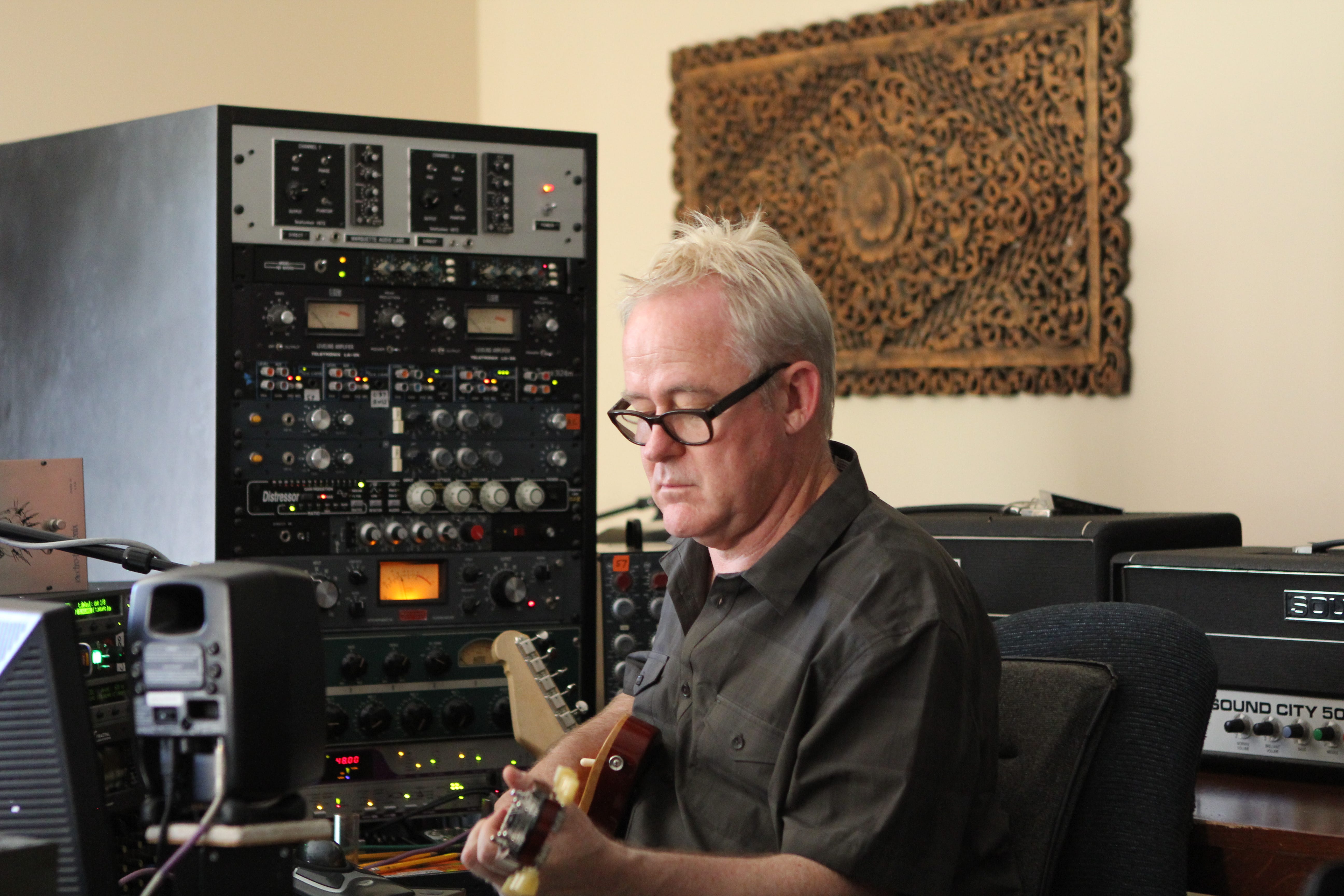
Having said that, though, I’ve seen videos of your home studio, and it looks like you’re sitting in the cockpit of a 747.
Well, I live in an environment where people over the years end up collecting a lot of gear, and I am no exception. My collection is very modest compared to some of the people that I know and work with.
You don’t have the refrigerator-size trunks of gear?
Not anymore. And part of that is the industry has changed to where you want to be light on your feet. It’s kind of like the military—you want to come in with the smallest amount of gear, do the most amount of damage, and then move on. [Laughs.] Did I say that? Yeah. It’s really become that way. I’ve had the experience in the past where I would bring a truckload of gear, and people would get angry. If you’re working in a studio, you want your guitar player to show up with a few things, get the job done quickly, and then get the heck out of there. It’s nice now. It’s a smaller complement.
I remember when some of the L.A. guys would have cartage send over three giant cases of stuff.
There’s a very good reason for that. You make a phone call early on, and you say, “What do you need?” “Ah, just bring your stuff.” Because nobody wants to talk about it—they’re busy. Then you show up with 12 things, and it’s “Hey, you got a Jazzmaster?” “Well, of course I do. But I didn’t bring it.”
“Got an electric sitar?”
Exactly! It’s infuriating to show up and get asked that question.
Which pedals and amps get the most use from you?
Right now it’s Divided By 13 for the amplifiers, because it does have that sweet spot where you go, “Oh, that sounds like a guitar.” It’s slightly distorted, but fat-sounding. If you put up a sound that’s too clean, it doesn’t sustain. You have to get it to where it’s just about to break up and has the right amount of top and bottom. Some people use a Fender amp all their lives for that.
Where do you dial it in to get that on your amp?
It’s usually around 3, but on a Fender it can be around 6. I have a Wizard that’s great, and that amp is very clean all the way up to 7 and it distorts a little bit at 10, and that’s an awesome thing too. Every amp does different stuff. Paul makes an amp now that’s a clone of a plexi Marshall, and a plexi Marshall has its role. There’s less use for a Marshall sound right now in my world, because the sounds are more clean and more Fendery and more bloomy and more open. But every amp has its moment.
What about pedals? Do you have favorites?
Strymon – all their pedals are amazing. The Eventide pedals are amazing because they have wall warts and the fidelity is great. There’s a guy, Tom Bucovac, who’s one of the greatest guitar players I’ve ever heard, and he loves Boss pedals. There’s so much good stuff out there right now that you can almost kind of just throw a dart and get something good. But those are some good ones.
Ry Cooder told me that to get a really great sound on record, like Elmore James’ fire-breathing sound, you don’t turn the volume all the way up. You find a spot, like around 5 or 6, and that’s how to get a big tone on a record.
Yeah. What happens with guitar sounds is they begin to collapse. Distortion is a funny thing. It just depends on the part. The higher the gain, the more compressed it sounds, and the more it begins to collapse. Ry Cooder said another great thing, that he preferred pickups that are non-humbucking, because they are more like microphones. They’re open-sounding. Some of these discoveries take a long time. Like we all had sounds in the ’80s that really don’t stand the test of time. We’re all back to this very organic thing that you’re talking about. Sometimes you just go down the wrong road for a while.
Ry’s favorite Stratocaster has a pickup from an Oahu lap steel.
Yeah. Those really cheap pickups—they sound amazing. Just open and beautiful. The problem with cheaper guitars is they don’t intonate very well, so it’s hard to use them sometimes.
One of the common recurring themes I’ve heard from studio guitarists through the years is that after a while it becomes a grind. Is there anything you do at the end of the day to step away from music and refresh yourself to be able to project that joy the next day?
I’ve lived my whole professional life just staying one step ahead of burn out. One of the reasons I don’t play live is because I like the day to end at a certain time. I like to do a really intense session, and then be done at a certain point. So for me, the trick is I like to be outdoors, and I like for the workday to end at a certain point.
It’s an odd thing. I’ve been very successful, and I’ve thought that if I put an ad in the newspaper, it would be “Musician for hire. Doesn’t travel. Doesn’t work at night.” [Laughs.] I’ve actually been able to get away with murder. The way I refresh myself is by working insanely hard and then driving away at 7:00. Now, there are people I work until midnight with—I have no problem with that—but that’s how I’ve done it. I get outdoors. I’m lucky. Being able to make a living in the studio has been a good fit for me, because I like to go out and see things at night, and I like to work during the day.
###
Learn from the man firsthand! For video lessons, masterclasses, tabs, and lots more, visit Tim Pierce Guitar.
Related Reading:
The Golden Age of L.A. Studio Guitar
Carol Kaye: Interview With a Sessions Legend
An important word from our management: If you’re not a paid subscriber, please consider showing your appreciation by becoming one ($5 a month, $40 a year) or by hitting the donate button. Every paid subscriber has complete access to the hundreds of interviews, articles, and podcasts posted on Talking Guitar. If you already are a paid subscriber, thank you!
© 2026 Jas Obrecht. All right reserved.
###