
John Lee Hooker: The Complete 1989 Interview
“Blues so Deep, It Sends a Chill Up and Down Your Spine”
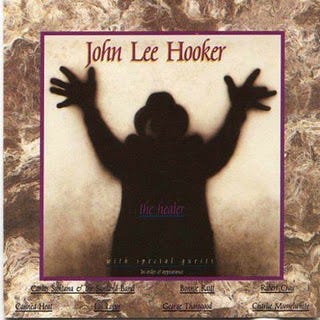
This interview, the first of several with my childhood blues hero, took place on the sunny afternoon of July 19, 1989. The setting was John Lee Hooker’s comfortable home in Vallejo, California. At that time, the walls of his living room were decorated with gold records, music awards, concert posters, letters from governors, and snapshots posed with George Thorogood, Jerry Garcia, Carlos Santana, and promoter Bill Graham. Hooker’s modest collection of about fifty albums included titles by Clifton Chenier, Wayne Cochran, Albert King, James Brown, Junior Parker, Champion Jack Dupree, Muddy Waters, Charles Mingus, and a few of his own albums. In his garage, the license plate of his white Cadillac read “Doc Hook,” while his sporty red Toyota was registered as “Les Bogy.”
The Healer had just come out, and Hook was thrilled to be on the comeback trail. Our conversation took place in the shade near his hot tub. It was originally published in the November 1989 issue of Guitar Player as “John Lee Hooker: ‘Blues So Deep, It Sends a Chill Up and Down Your Spine.’”
###
While The Healer features many well-known musicians, the strongest tracks are the ones where you’re by yourself, especially “Rockin’ Chair.”
That’s my favorite tune! The others is good for dancing, some of them, but getting right down to the nitty gritty and the real funk, this is it. Just playing the guitar, sittin’ there in my old-time rockin’ chair. A lot of people like that too. It is the closest to my heart. It, and another one on there—I can’t think of the name of it, but it’s with Musselwhite. Oooh!
“Rockin’ Chair” seems to be in the oldest style you play in.
Oh, boy! Whew! That’s direct to my heart. That’s a funky blues. People can just sit there and just meditate and think about how it feels sometimes. It’ll send a cold chill up and down your spine. It chills you, it’s so deep. Sometime when I play stuff like that, tears come out my eyes.
When you were working in Detroit in the early days, you often played like that, with just your guitar, a small amp, and your feet keeping the beat.
That’s the way I used to play. No band, no nothing. Just John Lee Hooker and his feet.
Did that style develop from playing by yourself a lot when you were young?
No, it come from my stepfather, Will Moore, from whom I learnt to play. He taught me how. I used to listen to him. My real father, he didn’t care for that kind of music in the house, because he was a minister. My real father and my mother, they wasn’t together. They separated or divorced or whatever. My mother, she got remarried.
How much of your style today is similar to Will Moore’s?
As the years went by, just a little bit changed with new, young musicians around. Well, maybe my basic style have changed a lot. I listen to my old records, way back, and look at my new stuff, and it’s a difference. What I’m doing now is still funky, but my old style was just nothing but me by myself just playing the hard, hard blues. Now with a band, it changes quite a bit.
If someone wanted to hear John Lee Hooker’s best guitar work, where should he begin looking?
I would tell him to start lookin’ at the years gone by. Back when I was younger coming up, I was playing more hard blues by myself. I could play more guitar and do more by myself. I could do the same thing now if I went on and started playing by myself. But to get the best hard stuff I did, you want to go back to the Detroit days when I was playing by myself in coffeehouses. I played more guitar. I had no band to interfere. I didn’t need to give no band no breaks and solos. I could do what I wanted to do when I wanted to do it. With the band, it gets in the way a lot.
A band restricts you to playing in a certain format.
Yeah! Now you said it. When you got a band, you got to concentrate on what to do. When I’m by myself, I just do it when I want, change when I want, not change when I don’t want. I can sit there and play a whole lot of guitar and just go to it.
Do you see a similarity in your approach and Lightnin’ Hopkins’?
Oh, yeah. Lightnin’ did it all the time. That’s where he was comin’. He didn’t believe in all them bands and things.
Are there certain blues albums that you like to listen to a lot?
Oh, yeah. I would start with Albert King and Jimmie Ray Vaughan—well, Stevie Ray Vaughan. Jimmie, too, is nice. Layin’ these blues on you. And Muddy Waters and on and on. The great ones have stood here and then have gone, but they still live on in my memory, whom I love so much. Just a great memory.
Right now, it seems like there are tens of thousands of blues guitar players.
Whoo! Well, I hate to say it, but it seems like there’s too many. And a lot of them is really good! They are good ones, but if you look around, a lot of ’em sound alike. You hear one, you just about done heard them all. So in your mind, they all are good, but if you go in to record with them, you just say, “Hey, this guy sounds like so-and-so. He sound like B.B. He sound like Stevie Ray.” They don’t have a unique style all to themself, like I got. Some of them play a tremendous lot of guitar—they play much more guitar than I do—but what I play is with a solid drive, a funky beat, and nobody got it but me! That’s what make me stand out. In fact, all of them sound almost alike—do do do do do [mimics stratospheric wailing high on the fingerboard]. It’s good, but…
You know how some guys try to copy another player exactly?
Yeah!
What would you have someone learn from you?
That’s a good question. What would I have them learn from me? Just learn to stop trying to make all the fancy chords and a whole lot of guitar all the way down the neck real fast. Forget about the fancy chords and concentrate on just a funky beat and something with a lot of soul and just a feeling to it.
You’ve played with dozens of great guitarists, from Eddie Kirkland on down to the musicians on your new album. Which of them could send chills up and down your spine?
Albert King [laughs]. I don’t know why, but there’s just something about his guitar. He got a outstanding style of his own, and a lot of people try to copy him too, but they don’t get it. I don’t know, there’s something about Albert—I hear his voice and his guitar, and it just chills me.
He’s one of the last guys you’d want mad at you.
[Laughs.] He sure as big as this house! He’s the last guy I want mad at me! Yeah. Well, you know, me and him good buddies. I respect him; he respect me. We’re always glad to see each other. B.B.’s the same way. Me and him are really good friends. He’s a tremendous guitar player. A lot of ’em try and sound like him. I think he changed over the years too. He’s gone to the big-band style, the Las Vegas style. But he can play some hard blues when he just want to. But he don’t do too much of that now. He’s on the Vegas trip and circles. That’s where you make a lot of money, but with me, I just like to please myself.
Throughout your career, you’ve seemed to remain true to your own vision of music.
Yeah. We all like money, you know, but the main thing is, I want to please myself. I’m doin’ alright money-wise, but I want to play what pleases me. I don’t want to play Vegas circles. I want to please the other people, but I want to please myself too. And so I just stays in what pleases me. When I was making this record, I had all these good people on it, but it was an entirely different style, like “The Healer” and Los Lobos. But I said, “Hey, I got to play some funky blues on here. I want to play some funk.” Now, this other stuff will sell real fast, like Los Lobos and Carlos Santana—I’m sure they’re going to go AM—but I wanted to please myself. I wanted to play some deep funk!
When you were growing up in Mississippi or working in Memphis, did you ever dream about someday being one of the greatest bluesmen in the world?
No, it didn’t never occur. I know I had the know-how. I know I had the stuff to do it with. I know I had the voice. I know I had the unique style. But I never would have thought that I would have come to get my foot in the door where I had a chance to prove what I could do. I never knowed that I would come to be this great, this popular on this planet, enjoying these things as one of the greatest bluesmen in my field that is. But I always thought I could be if I had the chance.
Did you work in the Ford Rouge plant after you moved to Detroit?
Yeah, I was a janitor. I pushed a broom. I was so into my music, but I had to work to survive. I always did like to be independent. I wanted to be on my own. I didn’t want handouts, and I had to work to support myself. And I didn’t want to be doing it in the factory. I would play my guitar at night, be up late, and they would catch me asleep, wake me up. They wouldn’t fire me, because at that time it was so union. And then they wanted help so bad, they did give me all kind of chances. They’d wake me up if they found me asleep [laughs]: “Little John”—they used to call me Little John—“John, get up! Wake up.”
Back then, you recorded under a lot of different names—Texas Slim, Delta John, John Lee Cooker, John Lee Booker. Did the record companies give you those names, or were they your idea?
That was me. I want to say this very slowly [looks carefully around the yard, tips his hat back, and leans forward]. I was the hottest blues singer when I got my foot in the door with, like, “Boogie Chillen,” “In the Mood,” “Hobo Blues,” “Crawlin’ King Snake.” Everything I did [snaps fingers] just turned to gold. I had this manager, Elmer Barbara, and all these record companies would come to him. They said, “This kid got something so different.” And I was under contract with Modern Records in L.A., and they was crooked—some of the biggest crooks ever lived. So Barbara would come to me late at night and say, “Man, I got a deal! This record company want to do something with you. I know you under contract, but we can change your name.” I said, “I don’t care,” and this kept going on. Every different little record company would come to me, and I’d say, “Call me what you want to—as long as you got the money.” They did give me a name, and I went in the studio late at night.
Would you change your style?
Sometime, but the company knew. There wasn’t nothin’ they could do about it.
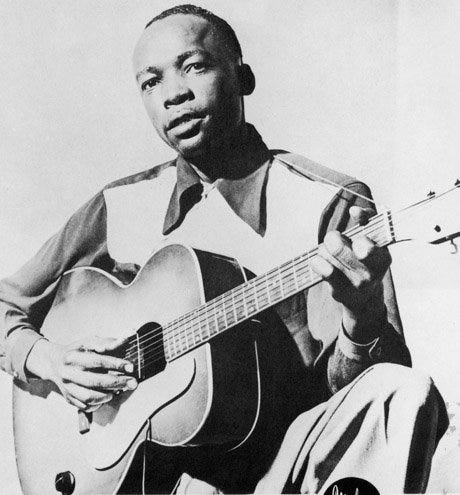
How would you record guitar back then?
I had an old Stella with a pickup in it. I thought at that time it was a great, great sound. Tremendous sound that was really good until the electric come along. T-Bone give me my first electric guitar. Then I thought that was the best I ever seen. It was a Fender—no, no, it was Epiphone.
Given your choice of any amp, what would you choose?
Fender. I love Fenders and Gibson guitars. I thought two or three times about endorsing Fender amplifiers—get ’em free, ’cause that’s all I use. I love the sound of the Twin.
What’s your favorite guitar?
A Gibson. I got two Gibsons and two Epiphones. [Rich Kirch, backup guitarist in Hooker’s band, added these details: “The Gibson ES-335 that John uses now—serial number 26201—was given to him by Carlos Santana on his birthday several years ago. He plays that one all the time. His blonde Epiphone is his favorite one; it’s on a lot of the old records. I’m not sure what year it is, but it’s a semi-hollowbody with a single cutaway. He also has a Lucille guitar—the Gibson B.B. King model—and another 335. He gave one of the 335s to Junior, his son.”]
You’re holding a Les Paul on one of your early albums.
Yeah, that’s when I first started out.
Do you ever use picks?
No.
How do you tune your guitar?
Regular tuning and open tuning. Open A and open G. [Kirch adds, “John plays most everything in E, except to boogie, when he usually tunes three strings up so he’s in open A.”]
Have you ever been interested in playing slide?
No.
Why?
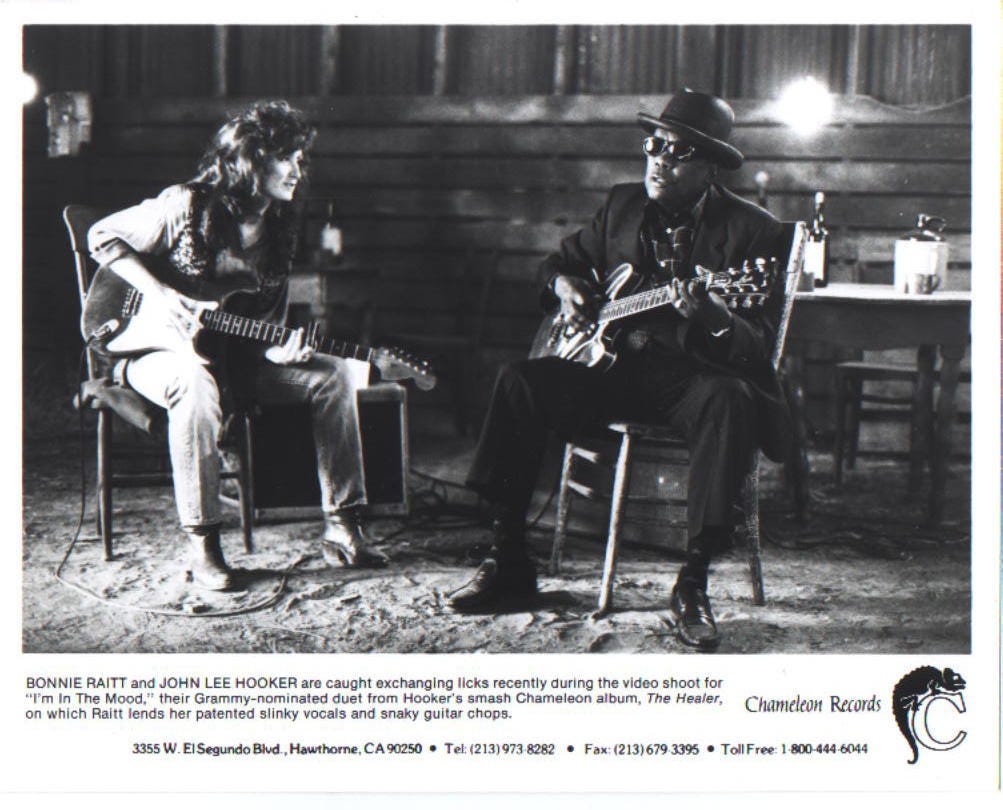
No reason. I just never did care for it myself. I love to hear it, but for myself, I wasn’t into it. I didn’t want to do it. It wasn’t the sound that I wanted, which is good. Oh, I love Bonnie Raitt’s slide; she’s one of the best slide players I ever heard in a long time. She’s one of the unique ladies I ever seen. I love her voice, I love the style of guitar. She can do that slide.
Your cousin Earl Hooker was great too.
Oh, yeah. Well, he was number one. Bonnie Raitt got her style from Fred McDowell. She used to go out there [to Como, Mississippi]. I knew him real well.
If you could put together an all-star blues band, who’d be in it?
That’s a good, big, big question. The famous people, like? Well, you can only get so many guitars in one band, so I would say Albert King—the Big Man, I call him. The others, right now I really can’t put my hand on it, but number one, I really would pick Albert King to be one of them. There are many, many more that’s good—tremendous good. Of course, I don’t copy him; I don’t do none of his stuff. But I don’t do none of nobody’s stuff but mine. So I’d get him first, and all the rest of it I’d fill in.
If I could pick one who’s gone, I’d pick Otis Spann. He was one of the greatest piano men that ever lived. Drummer, I don’t know. There’s some funky bass players. The guys that I’m used to playing with—and I heard a lot of ’em —one of them’s gone, Geno Skaggs. The young kid I got now, Jim Gayette, I never thought he was that good until I really take a good listen to him. He’s a funky little bass player—he play funk, play rock, play it all.
Did you know any of the early bluesmen, or were you familiar with the work of, say, Robert Johnson or Blind Lemon Jefferson?
I didn’t never know any of those gentlemens; I only know them through my stepfather, so I don’t have too much to say. I don’t know their background, but all the blues today—they was the root of all that music. It come from them. It come up progressive from those guys, and it could rise and rise and rise, but it was still from them. They was the one who created all of that.
When you began performing, did it seem almost impossible that a blues performer could play to a white audience?
Right. No, you couldn’t imagine it. But I had a feeling that it was comin’, but when? I know it would come sooner or later. Now it’s here in the full. I know back then that the blues was only for the older black people in just a certain area. You get a hit record then, it wouldn’t be half of the hit it is now. Just a half a big hit now is big, but back then the #1 record didn’t make a lot of money ’cause it only went to a certain people, the older black people. But down through the years it all changed.
Is right now a good time for the blues?
Oh, yeah. All over the world. To the non-English-speaking people, Japanese, France, Russia, the Communist countries, the blues have just cut their way into every country in the world, all over the world. Young, old—they found out the true identity of music that is the blues. It is the first music was here. It is the one tells the story. It is the one to tell the life story of a human being or a man and a woman. Who started this? Eve and Adam in the Garden. When the blues was born, it was born with Eve and Adam.
Over years and years and years, they beginning to find out the roots of this stuff and what it means to people. The rich, the poor—they all have the blues. No matter how much money you got, when your woman or the one you love have left you or you can’t get along with her, all the money in the world cannot fill the place of happiness in your home. Because money can’t talk to you. So that’s the reason the rich people, they get the blues. They get worried and upset, and then they can’t talk to that money at night. They can only spend so much, but they cannot buy happiness. So everybody realizes that now. The young, they study the blues. It’s in the library. They read about it.
See, what they call rock and roll haven’t been around over 35 or 40 years. What is rock and roll? That was all taken from the blues. Everything that we are saying, they are saying: “My woman done left me [scat-sings a solo].” The blues was saying all along, “My woman done left me heartaches,” or, “My baby gone, she won’t be back no more.” Well, rock and roll say the same thing, but they got the really up-to-date form and they call it rock and roll. It’s the blues!
Johnny Shines tells of how a guy could walk up to a bus stop and tell people how his house just burned down and his kids died, and most people would walk away.
Right.
And yet that night those same people might spend $10 to hear him sing about it in a club.
Right. Oh yeah! Yeah, you know, that’s the blues. The blues is here to stay. That’s all I can tell you. And they stronger than ever. I have to admit that when I first started playing the blues and first started making a record, I wasn’t making that much money. Just a little bit, but at that time I thought it was big money. You know, you make $1,000 for a week or $500 a night—that was big money to me. But now I consider $500—I go out for dinner a couple of times, it’s nothing. But back then that was a lot, a lot of money. Now all the kids, especially the young white kids, oh, they eat the blues up. They love ’em. And they playing them too. The young kids, they can play them. It first got big in England. The blues got real big in England before it got big here in the ’60s. The Stones and Animals and things like that—ooh, boy!
The Animals’ cover of “Boom Boom” is probably where most white kids in the 1960s heard of you for the first time.
It was! It was! And when I went overseas, it was just like God just let Jesus go over there. That’s all you could hear: “John Lee Hooker!” But they had never saw me. But everybody over there was playing my stuff.
Was the audience very different from what you were used to?
Oooh-whee! You know, this is the truth: Before I got to the concert hall—even if it was rainin’—the place be full with a line around the block. They had to start puttin’ on two shows a night to accommodate those people. Before I got there, the guys was playing all my music—Eric, Jimi, Georgie Fame, Spencer Davis, they all was doing it. John Lee Hooker. And then on the radio it was big over there. When I went over there, oh boy, it was just like the President coming. It made me feel good, you know. That’s where it started from, and then I come back over here, and it started catching over here real big. Then everybody in the world got it—the white kids, the black kids.
When the white kids became interested in your music, did you lose some of the black audience?
No. With dedicated fans, no matter who come in, they still are gonna like who they like. Just like a baseball team. I live here and I like the Giants, but I’m a strictly Dodger fan. Although they ain’t doin’ nothing, but I still like ’em and I’m still with ’em. Oh, I love baseball.
What else do you like outside of music?
I love being home. I’m a regular home person. I like just to lay back.
Do you play guitar much when you’re home?
Oh, yeah.
During concerts, it sometimes seems that you compose songs on the spot.
Sometimes, yeah. Sometimes, no.
Do you have a good memory for songs?
I’ve got a hell of a memory. I don’t forget nothing. Once I get it in there [taps forehead], I just [snaps fingers three times]. I can lay down at night and think of a song, get up, and sing it word by word and don’t forget nary a word.
Do you sing songs that aren’t blues?
Yeah. Like The Iron Man with Pete Townshend. And I was surprised I did that. He kept telling me I could do it, and I cut it in New York. That was completely out of my style, but it don’t sound bad.
You also contributed a version of “Red House” to a Jimi Hendrix project, Variations on a Theme—Red House.
Oh, yeah. I did it real bluesy and funky. That’s really nice. Mr. Jimi Hendrix, one of my favorites. He was one of my idols, and I was glad to do it. The guy that used to manage him [Alan Douglas] said Jimi would talk about me a lot, and he was the one who had me do this. It’s going to be in music stores for people who like Jimi Hendrix and stuff like that.
Did you know Hendrix at all?
No. I wished I had, because I was a great fan of his.
You seem to have a very smart business sense.
Oh, yeah. I’m very deceptive. Money ain’t anything, but I just don’t run through it. I know I’m not going to be doing this all my life, and I know that if I live on, I’m going to retire and just have a good life, a good home, and have money to kick back and do what I want to do, go where I want to go. Some of them live so fast when they’re making big money, they run right through it. And when they can’t do this . . .
Did you learn that lesson the hard way?
Yeah [laughs heartily]. Yeah, yeah, I did. I learned it the hard way. But now I’m very well set. I got a pretty nice home. I’m into real estate. I got three more homes in Oakland that I leased out. But like I said, I learned it the hard way. I could have run through partying, women, whiskey, living the fast life, and I wouldn’t have had nothing. You get through, and it’s just a dream. It’s a dream you went through, and you got nothing—all that stuff’s behind you. And then when you’re old, that’s gone. When all your money and success is gone, all your so-called friends are gone. They ain’t friends; they leeches that hangin’ on as long as you got something. I learned it the hard way.
I love people—don’t get me wrong. Oh, I love people. Friendship is the best thing in life. I go out of my way to help people. I’m a kindhearted person. I have a lot of people; I know some of them appreciate it, some of them don’t. I hate to say it: Some of them are leeches. I know they are, but I don’t tell them. I know what they’re thinking before they do it. I know. I can look right through people, but I still love ’em.
And you’ve always got your guitar.
Yeah, always got that! When the women gone, I always got my guitar. My woman can leave me, but my guitar ain’t gonna leave me. Always got that. Remember that song “Red House” that Jimi did—“way back yonder ’cross the hill”? He say, “I still got my guitar!” [Laughs.] Yeah, I still got my guitar.
###
For more John Lee Hooker:
John Lee Hooker: “Live at Café Au-Go Go”
John Lee Hooker Plays a Detroit High School, 1966
B.B. King and John Lee Hooker: Their Only Interview Together (Audio)
John Lee Hooker: The Complete 1996 “Living Blues” Interview (Audio)
Buddy Guy and John Lee Hooker Talk About the Blues
Transatlantic Blues: How American Bluesmen Energized British Rock and Roll
Detroit Blues: The Eddie Burns Interview
Listen up, blues fans! Even old-school music journalists need food, shelter, and inspiration. If you’re not a paid subscriber, please consider showing your appreciation by becoming one ($5 a month, $40 a year) or by hitting the donate button. Every paid subscriber has complete access to the hundreds of interviews, articles, and podcasts posted on Talking Guitar. And if you already are a paid subscriber, thank you!
© 2026 Jas Obrecht. All right reserved.
Great interview. And timely (for me). Just picked up an old JLH album on Vee Jay at an antique shop in Port Huron and can't stop listening to it.